AsDecember 2025 unfolds, skywatchers are in for a celestial treat. From the brilliance of a supermoon to the fleeting presence of an interstellar comet, the month promises a series of extraordinary night sky events that are sure to captivate stargazers worldwide. This month marks a particularly eventful time for those who love observing the wonders of the universe. With a range of phenomena visible to the naked eye and others requiring telescopic assistance, December’s night skies are set to deliver some of the most breathtaking astronomical spectacles of the year.
The Supermoon Spectacle (December 4)
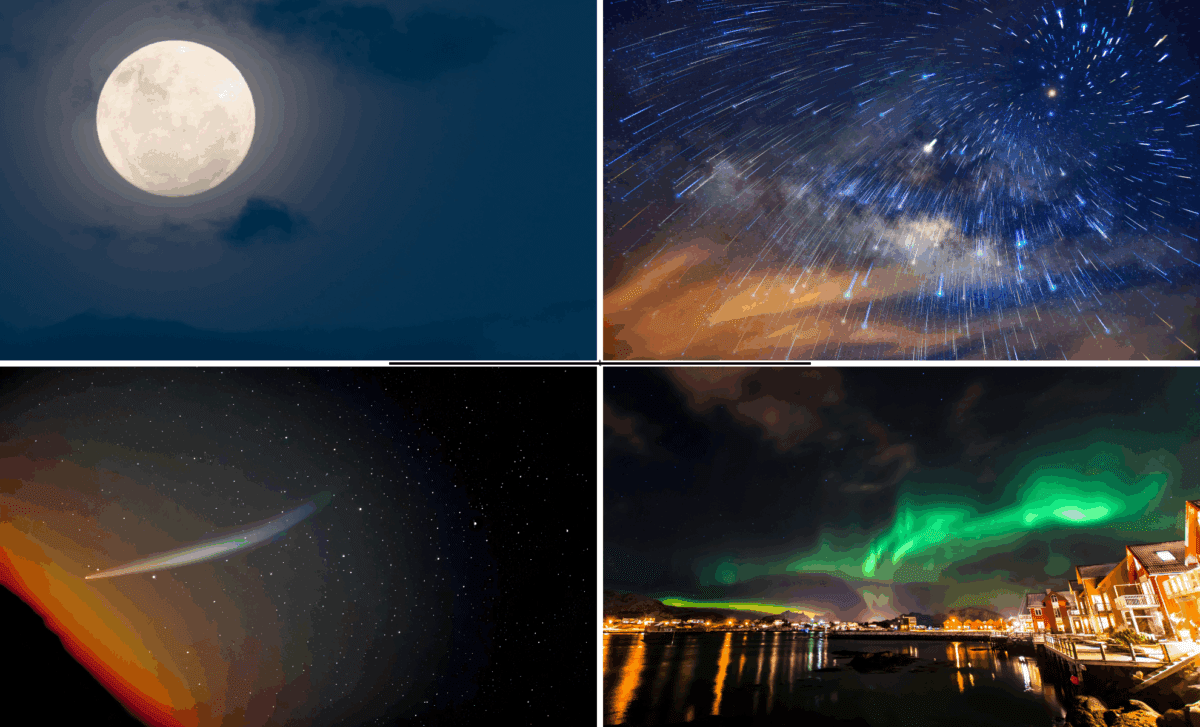
One of the most anticipated events in the sky this December is thesupermoon on December 4. The term “supermoon” refers to the phenomenon when a full moon coincides with the moon’s closest approach to Earth, known as perigee. On this date, the moon will appear up to 14% larger and 30% brighter than its typical appearance when it’s farther from the planet. The visual effect is mesmerizing, with the moon seeming to hover majestically over the horizon, creating an awe-inspiring sight. This event provides an ideal opportunity for photographers to capture the moon in all its glory, especially during moonrise, when an optical illusion makes it appear even larger against the backdrop of earthly landmarks like trees, mountains, and buildings.
For many, the supermoon is a reminder of the vastness of space and the dynamic movements of celestial bodies. As noted byNational Geographic, this year’s supermoon is especially notable because it marks the last of the year, offering one final chance to witness this extraordinary phenomenon.

Mercury’s Greatest Elongation (December 7)
On December 7, Mercury will reach its greatest elongation, a moment when the small planet is visible at its widest separation from the Sun in the morning sky. For many, Mercury is often elusive, remaining close to the Sun and hidden by its glare. However, on this day, stargazers will have an opportunity to observe Mercury in all its splendor just before sunrise. To catch this rare event, viewers should look to the eastern horizon, where the “swift planet” will rise just an hour before the Sun. Venus will also be in close proximity, adding to the splendor of the pre-dawn sky.
The key to viewing this event is ensuringthe sky is clear and dark before the Sun rises. Astronomers often recommend using binoculars or a small telescope to enhance the view of Mercury’s small, but unmistakable disk. As with other astronomical phenomena, this event is best observed from remote, dark areas free from light pollution.
The Geminid Meteor Shower (December 13-14)
For those who love meteor showers, the Geminids, which peak on the night of December 13-14, promise to be a highlight of the month. Known for its reliability and high frequency of meteors, the Geminid shower typically produces 60 to 120 meteors per hour under optimal conditions. This year, the shower’s peak coincides with a relatively dim crescent moon, ensuring clear skies for uninterrupted viewing. The meteors themselves are often yellow-tinged and include especially bright flashes, called fireballs, which can light up the sky with their brilliance.
Unlike some meteor showers, which are known for producing brief streaks of light, the Geminids are often more enduring and visible to the naked eye. For the best experience, stargazers should look toward dark, open skies away from the glow of city lights. If the skies cooperate, this will be one of the most spectacular meteor events of the year.

The Orion Nebula: A Cosmic Nursery (December 15)
On December 15, skywatchers should take the opportunity to view the Orion Nebula, a massive star-forming region located in the constellation of Orion. This nebula, known as Messier 42, is one of the brightest and most prominent star-forming regions in the sky, making it visible to the naked eye under the right conditions. However, with a telescope, observers can see the nebula’s famous wisps of gas and dust in stunning detail, with hues of blue, pink, and green swirling in the cosmic mist.
The Orion Nebula is often referred to as a “cosmic nursery,” as it is a region where new stars are born. This makes it a prime object of interest for astronomers studying stellar evolution.
Comet 3I/ATLAS: A Rare Interstellar Visitor (December 19)
One of the most exciting events this December is the passage of Comet 3I/ATLAS, a rare interstellar visitor from beyond our solar system. On December 19, this comet will make its closest approach to Earth, coming within approximately 170 million miles of our planet. Although it won’t be bright enough to see with the naked eye, those with telescopes or access to observatories will be able to track this ancient object as it passes through our solar system.
What makes Comet 3I/ATLAS particularly fascinating is its interstellar origin. Astronomers believe the comet may have traveled across the vast expanses of space for over seven billion years, originating from a distant star system in the Milky Way. It is only the third known interstellar object to pass through our solar system, a phenomenon that fascinates scientists and space enthusiasts alike. The comet will be located near the constellation Leo, and while it won’t be a blazing object in the sky, its rarity makes it a noteworthy sight.
The Winter Solstice and Auroras (December 21)
On December 21, the Northern Hemisphere will experience its shortest day of the year, marking the arrival of the winter solstice. For those in higher latitudes, this day also brings the potential for stunning aurora displays, as the minimal daylight hours coincide with heightened geomagnetic activity. The solar maximum, a period of intense solar activity that peaks roughly every 11 years, is still ongoing, which means there’s a good chance of seeing the Northern Lights in regions like Scandinavia, Canada, and Alaska.
To catch the aurora, it’s crucial to be in a location far from artificial light pollution, ideally above the Arctic Circle. The auroras are best viewed in areas with clear, dark skies, where the green and purple waves of the aurora can dance across the heavens.
Saturn and the Moon: A Beautiful Conjunction (December 26)
While the Ursid meteor shower doesn’t boast the same intensity as the Geminids, its peak on December 21-22 still offers an excellent opportunity for stargazers to witness a meteor shower under a nearly new moon. The Ursids are known for their lower activity, producing about 10 meteors per hour at their peak, but with dark skies, these meteors can still put on a delightful show.
Unlike the Geminids, which are known for producing bright, colorful fireballs, the Ursid meteors are typically faint and fast-moving. The best time to see them is just before dawn, when the radiant point near the star Kochab in the constellation Ursa Minor is at its highest. While the Ursids may not overwhelm viewers with meteors, their subtle beauty is still a treat for those who appreciate the quiet wonder of the night sky.
On December 26, Saturn and the waxing crescent moon will appear close together in the night sky, forming a conjunction visible to the naked eye. The two celestial bodies will be separated by only about four degrees, or roughly three finger widths in the sky. This pairing provides a beautiful opportunity for observers to see Saturn’s bright rings and the moon in the same field of view, creating a stunning celestial scene.
This event will be visible in the southern sky after sunset, and the two will remain close together until they set below the western horizon around midnight. This is a great event for those who want to witness two iconic objects in the sky in close proximity to one another, making it a memorable moment for astronomy enthusiasts.
Jupiter Brightens as Opposition Approaches (Late December)
By the last week of December, Jupiter will begin to brighten as it moves toward opposition, a point when the planet is directly opposite the Sun in the sky. This makes Jupiter appear particularly large and luminous, and it will be visible all night long. Although the official opposition won’t occur until January 10, the planet’s increasing brightness in late December makes it a perfect time to catch a glimpse of this gas giant.
Jupiter’s moons are easily visible through a small telescope, and the planet’s iconic bands of clouds can be seen even with binoculars.
Enjoyed this article? Subscribe to our free newsletter for engaging stories, exclusive content, and the latest news.