The Democratic Party of Korea’s decision on the 16th to revise its original bill to establish a dedicated insurrection trial division reportedly stemmed from opinions within pro-government legal circles, including progressive-leaning legal professionals, that the bill had “significant constitutional violations.” The party feared that proceeding with the original proposal, as demanded by its hardline faction, would not only delay insurrection trials due to the court’s request for a constitutional review but also risk a constitutional court ruling against it. Such an outcome would deal a significant political blow to the Democratic Party. However, legal circles have criticized even the revised bill, arguing that it “still contains constitutional violations.”
The four major revisions the Democratic Party agreed to after a general meeting of lawmakers include changes to the composition of the recommendation committee for judges in the dedicated insurrection trial division. The original bill proposed that nine recommendation committee members be selected by the Constitutional Court secretary-general, the Minister of Justice, and the judges’ council—three each. However, the prevailing legal interpretation is that external involvement in judicial appointments is unconstitutional, as the Constitution grants the Chief Justice authority over judicial personnel matters.
Under the revised bill, the recommendation committee’s selection authority was limited to internal court entities, excluding external participation. Judges for the insurrection trial division would now be recommended by internal bodies such as the judges’ council of each court or the National Judges’ Representative Assembly, then appointed by the Chief Justice upon the Minister of Justice’s nomination. However, the specific procedures and methods for internal recommendations remained unspecified.
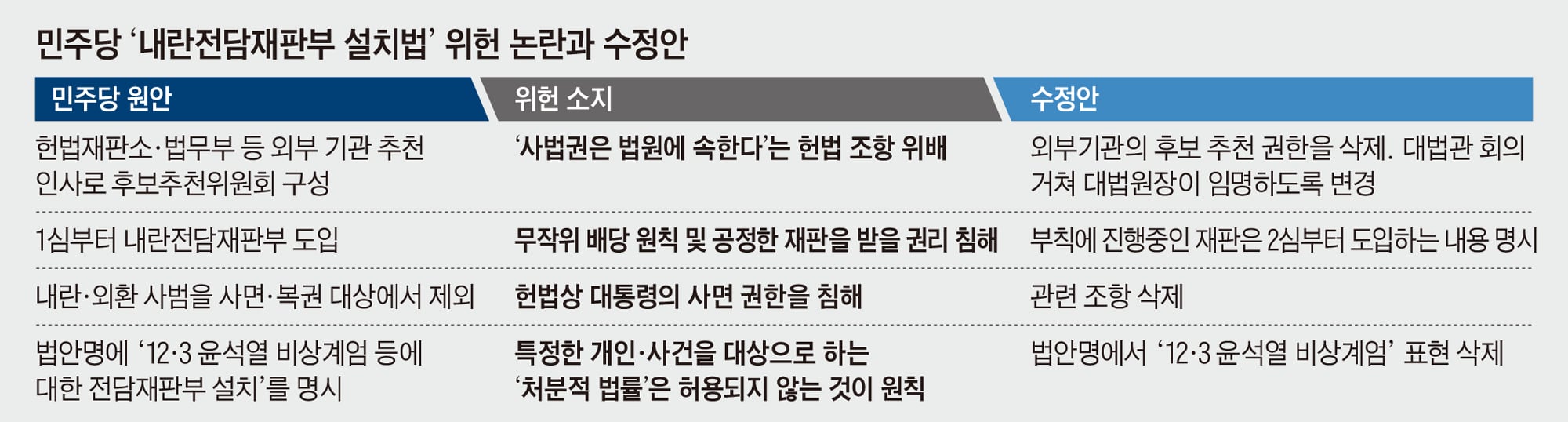
The Democratic Party also effectively revised the original provision to establish the dedicated insurrection trial division from the first trial to the second trial. While retaining the clause stating “from the first trial,” the revised bill added a supplementary provision exempting cases already under trial. This adjustment aimed to prevent delays in trials, such as that of former President Yoon Suk-yeol, if the division were applied retroactively. If finalized, Yoon’s insurrection trial will continue under the first-trial division led by Presiding Judge Jee Kui-youn.
The party also changed the bill’s title from the “Special Act on the Establishment of a Dedicated Trial Division for the December 3rd Yoon Suk-yeol Emergency Martial Law Case and Protection of Whistleblowers” to the “Special Act on Special Dedicated Trials for Insurrection and Treason.” Park Soo-hyun, the Democratic Party’s senior spokesperson, stated that this revision addressed criticisms that the original title constituted a “dispositive law,” which could infringe on basic rights by taking effect without judicial proceedings.
Additionally, the party reportedly removed a clause from the original bill that would have restricted presidential pardons for insurrection offenders, targeting former President Yoon. A party official explained, “While this clause will be deleted, we plan to amend the pardon law separately to block pardons for insurrection offenders.” However, the party failed to revise a provision allowing detention periods for insurrection and treason-related crimes to be extended up to one year. A senior party leader noted, “Due to strong opposition from hardline lawmakers, we couldn’t amend this part yet, but given the need to minimize constitutional risks, its deletion is highly likely.”
Initially, the Democratic Party aimed to swiftly pass the bill, as hardline lawmakers and strong supporters warned that delays could lead to Yoon’s release. However, concerns over constitutional violations from various sectors forced a pause. President Lee Jae-myung also conveyed at a leadership dinner on the 9th, “Reform legislation should be handled rationally to align with public expectations,” with many lawmakers echoing this view.
In response, the leadership under Chung Chung-rae commissioned a law firm to review the bill’s constitutionality. Even the pro-government-leaning firm reportedly raised concerns about constitutional violations. A pro-government official stated, “The firm not only questioned the creation of a separate trial division for specific cases but also argued that excluding the Chief Justice from selecting judges for the division and appointing them according to the ruling party’s preferences is unconstitutional.” However, some hardline lawmakers reportedly opposed the revisions, asking, “Why create a dedicated division if judges are recommended internally?”
Critics argue that even the revised bill fails to resolve constitutional issues. Yoon Jin-soo, a professor emeritus at Seoul National University School of Law, wrote on Facebook, “The issue isn’t whether recommendations come from inside or outside the court—creating a dedicated trial division retroactively is itself unconstitutional.” A high court judge added, “The principle of random case assignment, central to fair trials, is undermined by selecting judges through majority votes in a recommendation committee. How can we appoint new judges every time a politically sensitive case arises?”