
.
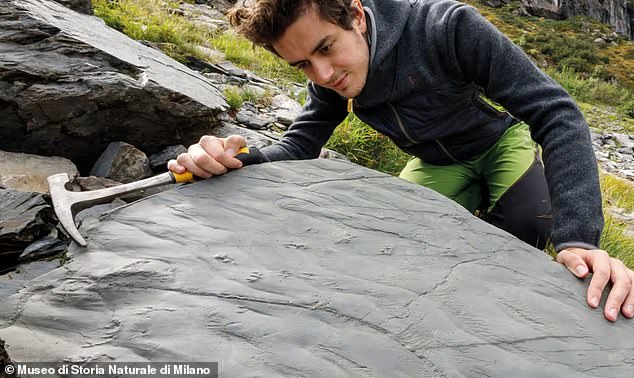
Claudia Steffensen and her husband were trekking along a trail in the Valtellina Orobie Mountains Park in Lombardy in 2023 when she spotted a light gray rock covered in ‘strange designs.’
When she looked closer, she realized the designs were actually animal tracks.
during the Permian period, the age immediately before dinosaurs.
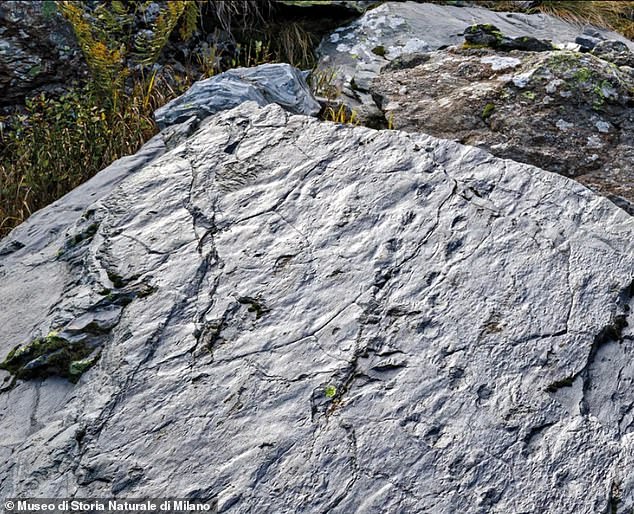
Further investigation of the region led paleontologists to hundreds of other fossilized footprints left behind by at least five species of ancient reptiles, amphibians and insects.
Though these animals predated the dinosaurs, some had to have been of considerable size, perhaps between six and 12 feet long, researchers said in a statement.
The team also uncovered imprints of plant fossils – including traces of seeds, leaves and stems – along with imprints of raindrops and waves on the shores of a prehistoric lake.
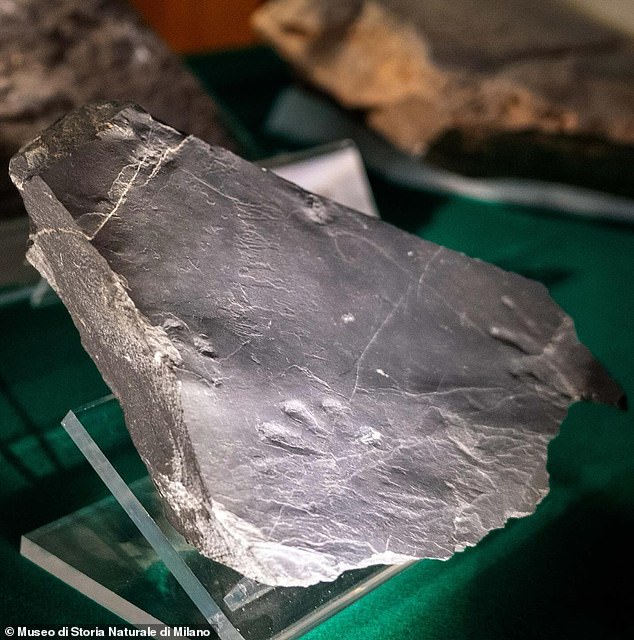
said the prints were preserved in ‘impressive’ detail, even down to ‘the imprints of fingernails and the belly skin of some animals.
The fine detail and remarkable preservation of these fossils is owed to their past proximity to water, the researchers explained.
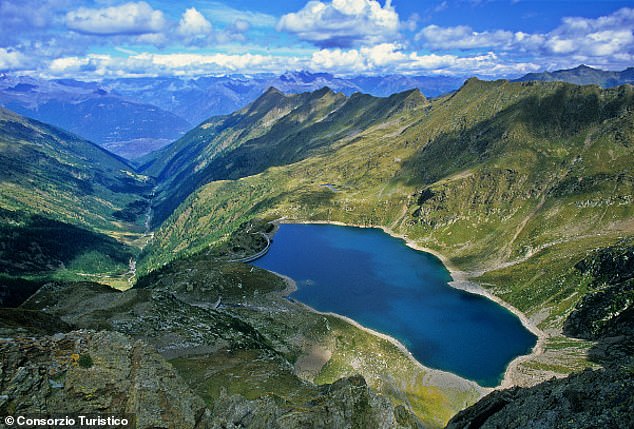
The ancient ecosystem, found at altitudes as high as 10,000 feet and at the bottom of valleys, was preserved in fine-grained sandstone.
Paleontologists also identified claw marks and patterns from the underbellies of animals.
.
‘The summer sun, drying out those surfaces, hardened them to the point that the return of new water did not erase the footprints but, on the contrary, covered them with new clay, forming a protective layer,’ Ronchi added.
The Permian period lasted from 299 million to 252 million years ago.
During this time, the global climate rapidly warmed, ultimately leading to a mass-extinction event that marked the end of this period and killed 90 percent of Earth’s species.
Ironically, modern-day global warming made the discovery of this ancient alpine ecosystem possible, as the fossils were hidden under layers of snow that have melted away as Earth’s climate has warmed.
.
‘The exceptional thing was the altitude – these relics were found at very high levels and were very well preserved. This is an area subjected to landslides, so there were also rock detachments that brought to light these fossils.’
.
The discovery of these fossils offers a window into an ancient ecosystem decimated by extreme global temperature rise. In this way, it also serves as a reminder of what’s at stake as anthropogenic warming nears catastrophic levels.
‘These fossils … testify to a distant geological period, but with a global warming trend completely similar to that of today,’ the researchers said.
‘The past has a lot to teach us about what we risk getting the world into now.’
Read more

Related posts:

Nickel Mining Threatens Tourism in Southeast Asia’s Fastest-Growing Economy

Rural Redwood Park: A Sanctuary for All Faiths and Reflection


Life on Mars? Scientists Uncover Long Organic Molecules on the Red Planet – International Edition
China wants to change the world with disruptive technologies. But what are they?