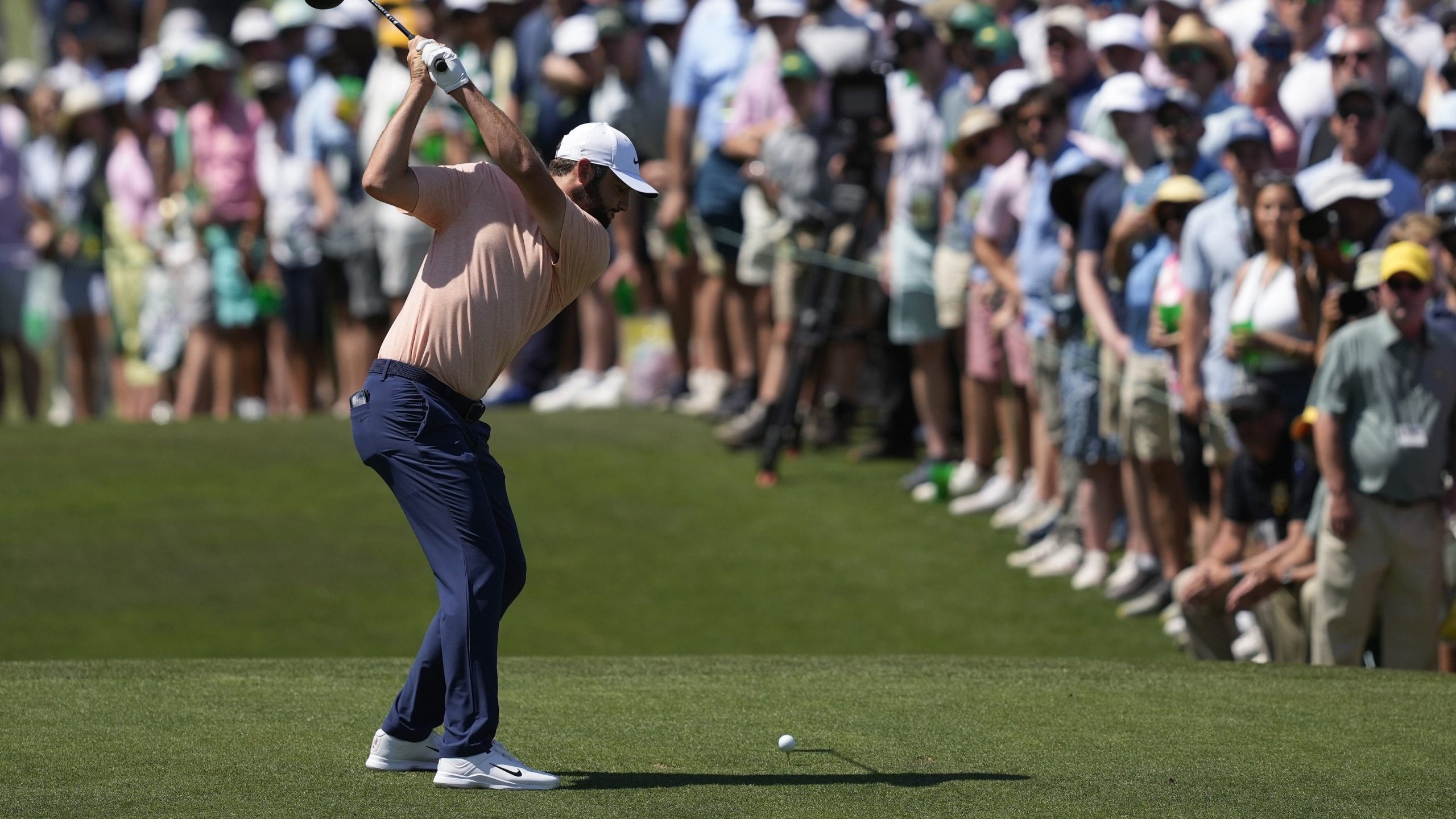
AUGUSTA, Ga. – At 350 yards, the briefest par 4 course at Augusta National remains unchanged since the inaugural Masters tournament took place back in 1934. No bodies of water obstruct play here; however, there is just one bunker positioned to the left side of the putting surface.
According to today’s standards, this would be regarded as a runnable par 4.
Nevertheless, there has been just one alteration to No. 3 in the club’s record, which occurred 42 years ago, when the big bunker situated left of the fairway was swapped for four smaller bunkers instead.
It comes as little surprise that Alister MacKenzie regarded the third hole, known as “Flowering Peach,” as one of his finest creations at Augusta National.
In a letter he sent to co-founder Clifford Roberts in 1933, he stated, “These very aspects maintain one’s engagement with golf for years on end, encourage players to enhance their skills, and stop the sport from growing monotonous.”
There’s no need to tell that to Tiger Woods.
In 2003, as part of his attempt to win an unparalleled third consecutive Masters title, he faced a critical decision during one of his rounds: should he play it safe with an iron from the tee or go all out with a driver aimed near the green? Choosing the driver, he sent the ball towards the trees instead. His following shot was played left-handed, but this led him to chip over the green. After chipping back onto the fringe, he ended up with a double bogey.
Maybe he should have taken heed of Seve Ballesteros’ words in the Masters Journal that year, where he penned that even using a driver, “a good shot doesn’t guarantee you’ll always be rewarded.”
“The unpredictability of this situation is filled with dramatic events,” the renowned Spanish figure noted.
And from the tee, it appears quite straightforward—the group of four bunkers to the left that many golfers can now easily reach, along with the deep bunker guarding the green and the raised putting area that has consistently served as the hole’s strongest defense.
It sits on a natural plateau coming from a hill, so it slopes from right to left. The best birdie chances are when the pin is back and to the right. Any pin on the shelf to the left?
“Terrifying,” Xander Schauffele stated, emphasizing the term as he mentioned it two additional times when talking about his approach.
Despite being within 100 yards, players aim about 25 feet to the right of the pin. Targeting the flag directly might result in overshooting, leading to one of the most challenging chip shots on the green.
Unexpected and brimming with excitement?
In 2022, Scottie Scheffler learned this lesson when he clinched his first Masters victory. Despite preferring drives beyond the bunker complexes, even at the cost of landing outside the fairway, he found himself extremely off course in the pine straw well to the left of where he should have been. However, his subsequent pitch slid downhill right back onto the fairway. From there, Scheffler managed an unexpectedly brilliant birdie, propelling him forward towards success.
“The front pin is more of a decision depending on how close I can get to the green,” Scheffler said. “But if you can get it up close to the front of the green, I think it’s a smart decision always to go for it.”
This has generally been the mindset during the past ten years, particularly since players have been driving it farther. Nevertheless, when faced with a 350-yard hole without any hazards, managing to make par doesn’t feel like surrendering a stroke to the competition.
“Should the pin be at the rear, I’m considering using my driver most of the time with a three-iron,”Billy Horschel stated.“However, if the pin is located elsewhere, I lean towards using a four-iron and am unsure about which club to use from the teeing ground.”
One of the most notable moments came when Charl Schwartzel holed out using a wedge from the fairway for an eagle back in 2011. That same year, he finished his round with four consecutive birdies, securing victory by a margin of two strokes.
The most thunderous instance? It was when 58-year-old Jack Nicklaus sank a chip shot for a birdie in 1998, momentarily leading everyone to think he might make another comeback.
And what’s even stranger? That oddity belongs to both Jeff Maggert and Bryson DeChambeau.

During the final round of the 2003 Masters, Maggert opted for a conservative approach using an iron from the tee but ended up in a bunker. The issue escalated as his next shot—a thin hit with a sand wedge—struck the edge of the bunker, bounced back, and struck him in the chest. At that time, this incident incurred a two-stroke penalty. Consequently, he recorded a triple bogey and lost his lead permanently.
Next up was DeChambeau, who famously called Augusta National a par 67 due to his ability to reach all the par 5s with ease, including the 350-yard third hole. However, during the 2020 Masters, his performance crumbled specifically at that same hole where he lost track of his tee shot entirely.
The fact that it was November with soggy turf and an absent crowd did little to assist. The ball remained undiscovered even after the search concluded, leading a frantic DeChambeau to inquire of a rules official, “Are you telling me that if we can’t locate it, it will be considered a lost ball?”


