“We will stay with you until the end, so do not give up.”
These were the words spoken by medical staff at Asan Medical Center, Seoul, to parents who pleaded for the life of their newborn, who was born with her heart outside her body. Alongside this encouragement, the medical team proceeded with surgery, and the baby, born with an unknown congenital ultra-rare disease, was eventually discharged in good health.
According to Asan Medical Center, Seoul, on the 17th, Park Seo-rin was born on April 10 of last year at 38 weeks of gestation at the hospital’s new wing delivery room, diagnosed with ectopia cordis.
Ectopia cordis is a congenital ultra-rare disease of unknown cause where the heart is located outside the thoracic cavity. It occurs in 5 to 8 people per 1 million, and over 90% of patients die before birth or within 72 hours after birth. In South Korea, there have been no reported cases of survival for newborns with ectopia cordis, and relevant international literature is extremely limited.
At birth, Seo-rin’s heart was completely exposed and beating outside her body. Her sternum, which should protect the heart, was absent, and the skin and soft tissue of her chest and abdomen were underdeveloped, leaving her thoracic cavity open. Every time she cried and strained, parts of her heart and lungs protruded outward, and her severely impaired lung function made it difficult to sustain life through spontaneous breathing.
Seo-rin was first diagnosed with ectopia cordis during a fetal ultrasound examination in November of the previous year. The test was conducted at a hospital other than Asan Medical Center, Seoul, and at the time, the parents were told, “It would be difficult to be born alive, and even if born, survival beyond three days would be challenging, so they should prepare themselves mentally.”
However, the parents could not abandon Seo-rin. After giving birth to their first child, they had longed for a second but faced infertility. After 14 in vitro fertilization attempts over three years, Seo-rin was a miraculous arrival.
Thus, Seo-rin’s parents sought help from Asan Medical Center, Seoul, renowned for its pediatric care. Their heartfelt resolve was, “We waited 14 times to meet Seo-rin—how could we give up?”
Experts from various fields at Asan Medical Center, Seoul—including Pediatrics and Adolescent Cardiology, Cardiovascular and Thoracic Surgery, Plastic Surgery, Pediatric Cardiac Surgery, Obstetrics and Gynecology, and Convergence Medicine—united to save Seo-rin.
First, Professor Lee Mi-young from the Fetal Treatment Center’s Obstetrics and Gynecology department conducted meticulous precision ultrasound examinations during each visit to monitor the heart’s structure and the fetus’s health. The primary physician, Professor Baek Jae-sook from Pediatrics and Adolescent Cardiology, and Professor Choi Eun-seok from Pediatric Cardiac Surgery searched for all possible research literature to guide treatment. Throughout this process, the medical team repeatedly encouraged the parents, saying, “The fetal heart structure is normal. We will stay with you until the end—do not give up.”
Seo-rin endured 38 weeks in her mother’s womb and was born on April 10 of last year. The real battle began from the moment of birth: her entire sternum was missing, and the skin and soft tissue of her chest and abdomen were deficient, leaving her heart beating entirely outside her body.
The medical team at Asan Medical Center, Seoul, discussed treatment directions to ensure her survival and decided to proceed in stages: securing space within the thoracic cavity to place the heart, then covering the area with cultured skin to reconstruct the chest. The immediate priorities were protecting the exposed heart from trauma, infection, and dryness, while maintaining respiration and body temperature. Artificial respirator therapy and sterile dressings were administered immediately.
On April 11, the day after birth, Professor Kim Eun-ki from Plastic Surgery performed a temporary surgery to cover the open chest and exposed heart with artificial skin.
Professor Choi Se-hoon from Cardiovascular and Thoracic Surgery conducted three surgeries on May 7, 14, and 22 to place the heart inside the thoracic cavity. This was a high-difficulty procedure requiring the creation of space for the heart while maintaining blood pressure and avoiding damage to surrounding organs. After the three surgeries, the entire heart was positioned inside the thoracic cavity. Subsequently, Professor Kim successfully transplanted autologous cultured skin, derived from a small sample of Seo-rin’s own skin, onto her chest.
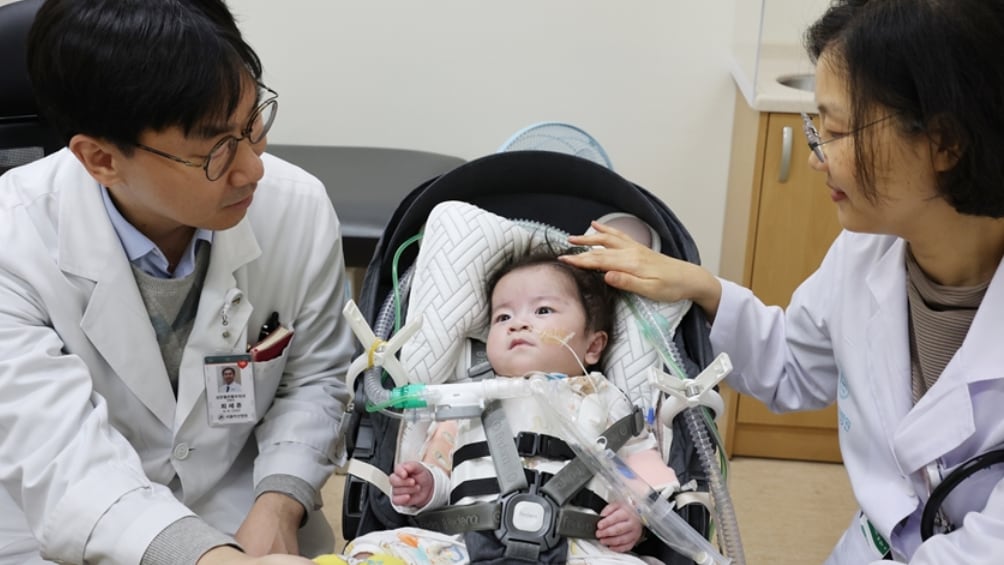
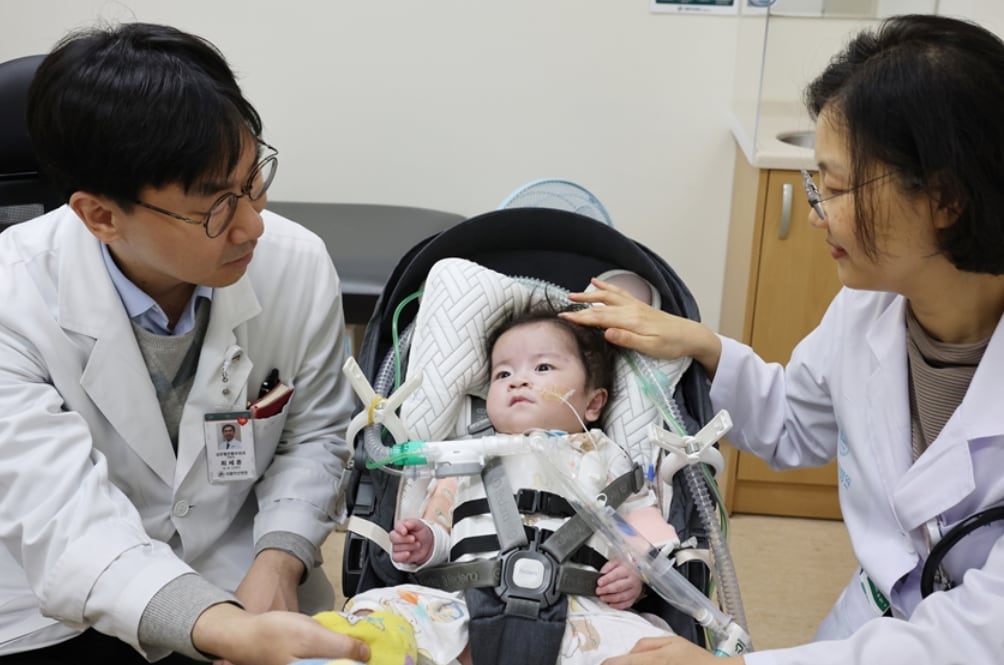
Simply placing the heart was not the end. The chest remained vulnerable to external impacts, as it was covered only by skin without rigid structures like bone. Professor Kim Nam-kuk from Convergence Medicine used 3D printing to create a customized chest protector that gathered both sides of the thoracic cavity to prevent the chest wall from spreading apart. The rehabilitation medicine team also provided therapy to help Seo-rin grow like other children her age.
Ultimately, Seo-rin gradually recovered and was moved to a general ward. She recently was discharged and is now growing healthily while receiving regular outpatient care. The small heart that once beat outside her body now beats vigorously inside, in its rightful place.
Seo-rin’s mother said, “All medical staff at Asan Medical Center, Seoul, did not give up and continued to find treatment methods until the end, giving us hope. We are grateful to the medical team for helping us return home with Seo-rin.”
Professor Baek Jae-sook stated, “At every moment of treatment, there were unexpected difficulties, but the small changes Seo-rin showed became a clear hope for the medical team. We hope this story of perseverance—taking one step at a time—inspires new possibilities and paths for children and families with rare diseases.”
Professor Choi Se-hoon added, “Saving a newborn with ectopia cordis, an ultra-rare congenital disease, is impossible through the efforts of a single doctor. Experts from various fields, each with sufficient clinical experience, shared evaluations and treatment directions from their respective perspectives, and through close collaboration, we were able to save Seo-rin.”