
Among photojournalists, covering the National Assembly is considered a “harsh terrain.” Schedules are tight, and dozens of people crowd into cramped spaces. Many days are filled with repetitive scenes like handshakes, speeches, and votes—scenes with “set answers.” Complaints arise that the effort put in does not yield standout results.
This year, photos capturing the mobile phone screens of National Assembly members sparked controversy when they were repeatedly reported. The act of photographing and reporting on the smartphone screens of public officials inside the National Assembly—dubbed “phone-screen journalism”—has solidified itself as a genre of parliamentary photojournalism.
Borrowed-name transactions, wedding gifts, personnel recommendations…the ripple effect created by mobile phone screens
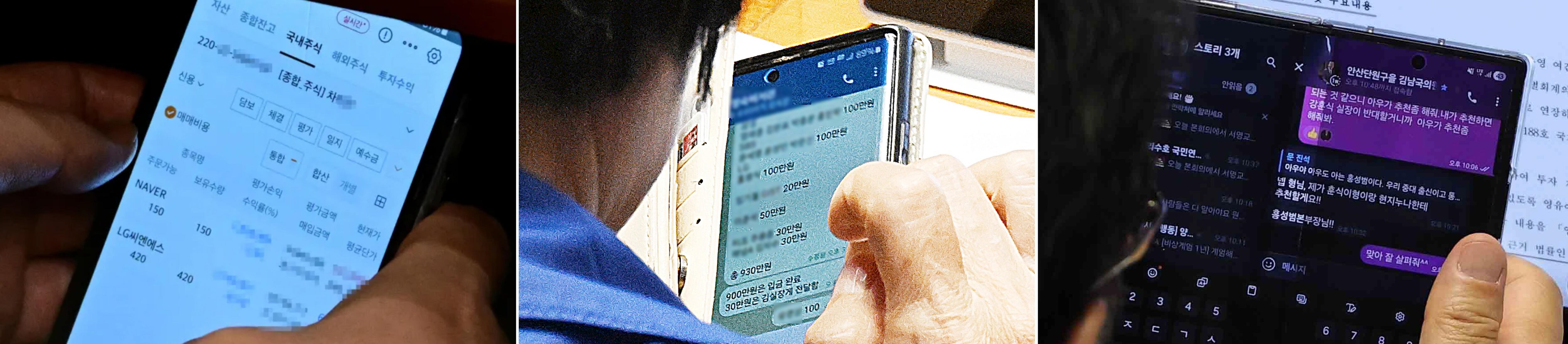
Three scenes captured at the National Assembly set the trend.
On August 4, a photo of Lee Chun-seok, then Democratic Party of Korea floor leader of the National Assembly’s Judiciary Committee, checking a stock trading screen on his phone during a plenary session was exclusively reported by The Fact. Allegations of borrowed-name transactions and conflicts of interest emerged. Lee explained, “I was using a staff member’s phone.” He later submitted a resignation as committee chair and left the party.
On October 26, a photo of Choi Min-hee, SIBCC president, reviewing and forwarding a Telegram message listing wedding gift amounts and names at the daughter’s wedding was exclusively reported by Seoul Shinmun. Her office stated, “This was part of instructing the return of gifts from supervised agencies.” As controversy grew, Choi apologized.
On December 2, a photo of a Telegram conversation between Moon Jin-seog, Democratic Party of Korea chief deputy floor leader, and Kim Nam-kuk, digital communication secretary, was captured exclusively by NewsPim, sparking a “personnel recommendation” scandal. The presidential office issued a stern warning to the secretary before accepting his resignation.
These cases show that mobile phone screens became the “clue” to suspicions, serving as the starting point for verification leading to explanations and follow-up actions. While overseas, secretly viewing someone’s screen is called “shoulder surfing,” photos from the National Assembly cannot be simply dismissed as mere peeking.
The National Assembly’s unique difficulty in claiming privacy infringement
Korean society is sensitive to portrait rights and privacy violations. Without consent, filming and reporting at public gatherings or official events with clear public interest can escalate into legal disputes.
Ironically, the National Assembly is seen as the hardest space for public figures to claim portrait rights or privacy. It is a public domain funded by taxpayers, and its members are elected officials. Not only speeches and votes but also their demeanor and actions become political news—sometimes shaking policy and power dynamics.
This context weakens the argument that capturing phone screens in plenary sessions or standing committees constitutes “privacy infringement.” Concerns about exposing private conversations or personal schedules are valid. However, in the National Assembly, public figures’ interactions and communications are subject to public judgment. The process of raising suspicions, seeking clarifications, and taking follow-up actions after reports is often viewed as a functional aspect of monitoring public officials and accountable governance.
The gaps in vigilance created by open spaces
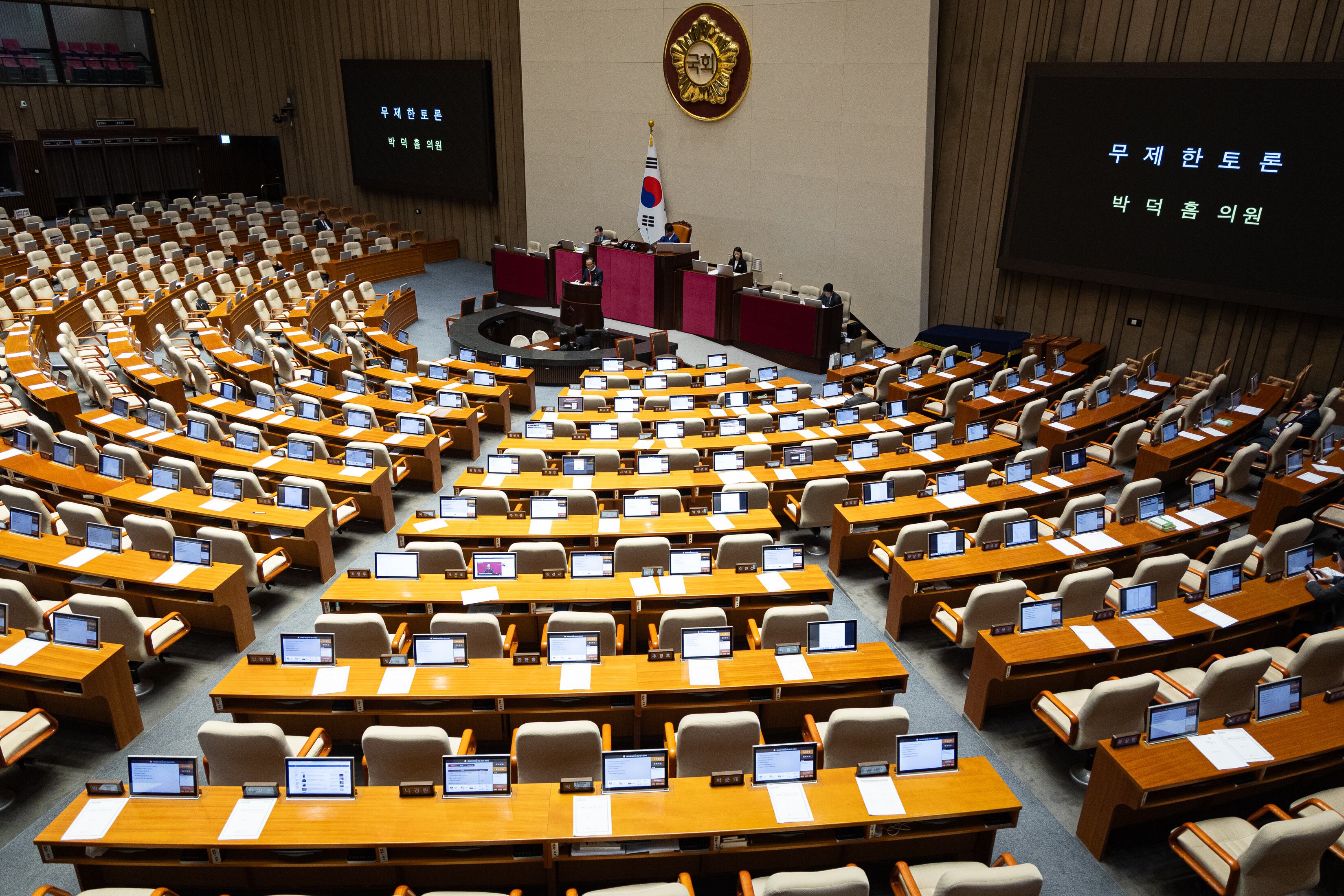
The National Assembly is a dense space where 300 lawmakers, support staff, government officials, party members, and stakeholders move simultaneously. Multiple issues unfold at once.
The plenary hall, in particular, has a spectator and press zone at the back, offering a wide view of the chamber. The open sightlines allow cameras to capture lawmakers’ subtle gestures, expressions, desk materials, and even mobile phone screens in their hands.
Participants in the chamber typically face the speaker’s podium, making it difficult to constantly monitor press members seated behind. As sessions drag on and message-checking becomes frequent, vigilance tends to loosen. Lawmakers in the back rows, closer to the spectator section, are more likely to have their screens caught by telephoto lenses.
Camera technology sharpening the clarity of text messages
In the film camera era, low-light conditions and sensor limitations made it hard to capture legible text from distant screens. Even with telephoto lenses, noise and resolution issues often blurred characters.
Today, advancements in high-ISO noise reduction, image stabilization, high-resolution sensors, telephoto lens sharpness, and autofocus performance allow text outlines to remain visible from afar. Basic post-processing—cropping, sharpening, and noise reduction—enhances readability.
AI-based upscaling further refines image quality, turning blurry text into “decipherable clues.” The high-resolution displays of smartphones used by lawmakers also contribute. Even encrypted messengers like Telegram become vulnerable the moment their screens are physically captured.
Photographs as evidence over aesthetics
Journalistic photos are typically evaluated for balancing news value and aesthetic appeal. A common belief is that excessive emphasis on one aspect undermines the photo’s quality.
However, National Assembly “phone-screen” photos defy this formula. The content of the screen, not composition or lighting, is key. When text messages or conversations reveal power dynamics, conflicts of interest, or misconduct, the photo functions less as an image and more as “evidence.” Still, ethical judgments in editing—avoiding excessive exposure of personal information—are critical.
The journalistic spirit seeking differentiation
Some view “phone-screen” photos as more than mere coincidence. Nam Yoon-ho, a reporter at The Fact who captured Lee Chun-seok’s screen, explained, “The desk editor assigned two reporters to the plenary session: one to cover essential scenes stably, and another to scout for unexpected moments.”
While ensuring essential scenes like votes, confrontations, and speeches are not missed, reporters must also observe subtle changes throughout the chamber. Dividing roles within a team expands the scope for capturing unforeseen moments.
The cumulative carelessness closer to power
Why does this pattern repeat in the National Assembly? Part of the answer lies in the complacency of the subjects. Ruling parties, especially those close to power, communicate frequently with the presidential office, government, and stakeholders. Phones are opened more often as work tools, and the line between public and private duties blurs. Small oversights accumulate until a single exposure ignites a scandal. Post-reporting remedies—like adjusting screen angles or messenger usage rules—are often too late.
The best protective film is ethical awareness
Even if lawmakers refrain from using phones in plenary sessions or apply privacy films, these are temporary fixes. Physical barriers only reduce exposure risks; they cannot change behaviors subject to public judgment.
Public officials must adhere to strict ethical standards, assuming they could be recorded at any moment. Hong Yoon-gi, the Seoul Shinmun reporter who photographed Choi Min-hee’s “wedding gift” screen, stated, “I believed it was right to report the scene as it was, without considering conflicts of interest.” Photojournalists’ documentation of public figures holds legitimacy as a form of power oversight. Mobile phone screens become controversy triggers because they intersect with public accountability, interests, and authority.