The Changing Landscape of Chitwan: Rhinos and Human Settlements
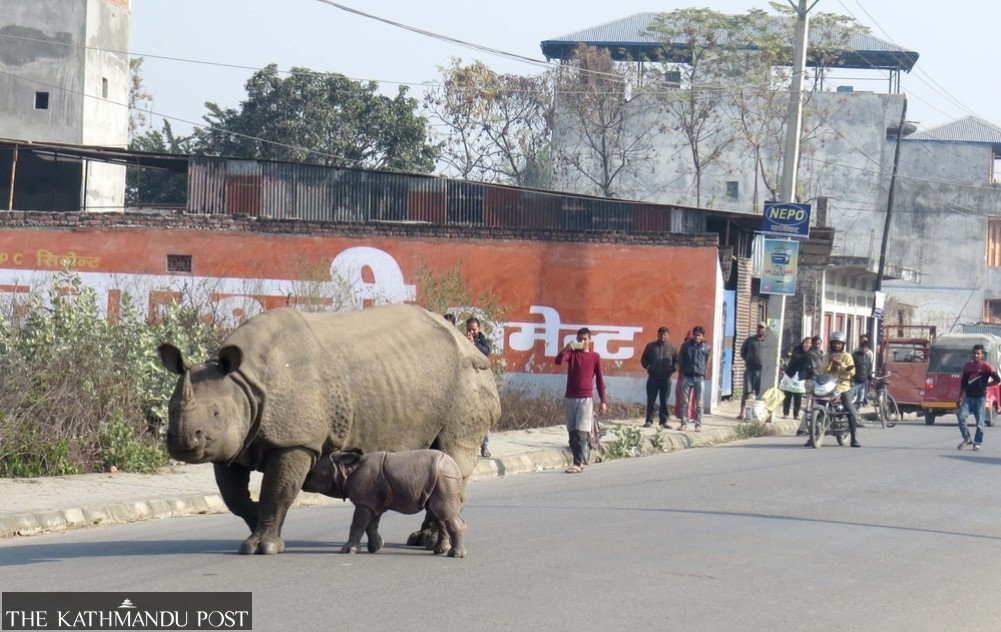
In the heart of Bharatpur, a scene unfolds that once seemed impossible. A horned rhinoceros runs under streetlights as onlookers capture the moment on their mobile phones. Others step back in alarm, realizing they are witnessing an unusual occurrence. As night falls, such scenes around Bharatpur’s Chaubiskothi Chowk are no longer rare. What was once considered an extraordinary sight has become an increasingly common intrusion by a conserved animal species.
This shift raises a broader question in Chitwan: Have rhinos entered the city, or have human settlements expanded deeper into their habitat?
Chitwan National Park remains Nepal’s primary habitat for the greater one-horned rhinoceros, drawing thousands of domestic and international visitors every year. However, the growing presence of rhinos beyond protected boundaries is reshaping life in nearby settlements.
Apil Ghimire, a resident of Patihani in Bharatpur who runs a Rapti river clean-up campaign, posted a video on social media showing a rhino running through Chaubiskothi at night. Alongside the clip, he wrote, “A rhino can appear anywhere in Chitwan at any time. That is not unusual. This is its home. We need to remain cautious.”
Wildlife researcher Dadi Sapkota posted another widely shared video on May 11 showing two male rhinos fighting on a road in Sauraha. He wrote, “The rhinos have not entered human settlements. It is the settlements and roads that have entered their habitat. This should not be surprising.”
Rising Risks in Settlements
While rhino sightings have become a spectacle for tourists, many residents living near the park boundary say they now live with constant fear and loss. In some cases, encounters have turned deadly.
Ambika Pathak, 60, lives in Narayani Dobhan Tole in ward 3 of Bharatpur Metropolitan City, around two-and-a-half kilometers west of Narayanghat. Her husband, 65-year-old Tej Bahadur Pathak, used to graze goats and often walked about a kilometer from home in the evenings. On January 31, Ambika received news that he would not return home again.
“He used to go out with livestock and return late in the evening. That night he never came back,” she said. “We found his body around one to one-and-a-half kilometers from home. We could not go searching at night because rhinos are often seen nearby. Someone found him in the morning and informed us.”
Residents say rhinos are now frequently spotted near their homes, sometimes with calves. Rajendra Kandel, chair of the Rameshwar Shanti Tole Development Committee in ward 4 of Bharatpur Metropolitan City, said rhino movement into residential areas has increased steadily over the past several years.
“There is a municipal forest nearby, and we have seen seven or eight rhinos there,” he said. “Earlier there were none, but their numbers have gradually increased. In the past year, sightings have become much more frequent.”
He said concerns about wildlife movement have also been raised during public hearings organised by the municipal office.
“Except for the death of Pathak, no major incident has been reported so far,” Kandel said. “But this is a settlement close to the city. The main market area is only two to three kilometers away. People leave home early in the morning and return late in the evening, which is also when rhinos are active. Fear among residents is growing.”
Expanding Range and Shifting Habitat
According to data published by Chitwan National Park in May 2023, rhinos have been recorded leaving the park through 127 different points. Movement into buffer zones and adjacent farmland is considered routine. What has become more noticeable in recent years, however, is their increasing movement into municipal forests and semi-urban areas.
The municipal forest near Pulchowk in Narayanghat lies close to residential settlements. From the Narayani bridge, rhinos grazing near human habitation can sometimes be seen along the forest edge. To the west lies a continuous belt of community forests under the Division Forest Office, which are increasingly being recognised as emerging rhino habitats.
Surbir Pokharel, former chair of the Federation of Community Forest Users Nepal in Chitwan, said rhino numbers in these forests have increased over the past two decades.
“They are now using these community forests as habitat. We have even seen rhinos with calves in these areas,” he said.
Pokharel said winter is the peak season for rhino movement. “In winter, grass inside forests becomes scarce, while crops such as wheat, maize and vegetables are available in nearby fields. Rhinos come out to feed. They even travel as far as the Rampur wetland, around four kilometers from the forest. Locals now call the area ‘Rhino Wetland’.”
Conservation Debate and Management Challenges
Tourism entrepreneur Aryal argues that rhinos frequently seen in new areas should be relocated back to their original habitats inside the park. “Earlier, rhinos were concentrated in the eastern sector of the park,” he said. “Now census data show their numbers have declined in the east and increased in the west. Rhinos from newer areas should be brought back and released in their original habitat.”
Local leaders in Bharatpur-4 have voiced similar concerns. Forest officials, however, say limited resources have restricted mitigation efforts. “We received a budget of around Rs500,000. That is hardly enough for fencing or setting up barriers,” said Devi Paudel. “Some work has been done, but it is far from sufficient.”
According to the last rhino census conducted five years ago, Nepal is home to 752 rhinos, of which 694 are in Chitwan National Park and surrounding forests. Wildlife attacks in buffer zones and nearby settlements remain a serious concern. According to Abinash Thapa Magar, information officer at Chitwan National Park, 10 people were killed in wildlife attacks in the park’s buffer zone in the last fiscal year. Eight of those deaths were caused by rhinos.
What is emerging in Chitwan is a fragile shared landscape where the boundary between forest and settlement is becoming increasingly difficult to define. The recent footage of the rhino coming dangerously close to humans spread widely on domestic and international media platforms.
The videos also renewed attention on Meghauli, a male rhino known locally for frequently moving between forests and settlements. It was rescued as a calf during the 2017 floods after becoming separated from its mother and was later raised under human care. Named after the area where it was rescued, Meghauli is now regularly seen around roads and farmlands in Sauraha. Conservation officials said the rhino occasionally crosses the Rapti river, moves into the Baghmara forest and later returns to the town area.
An attempt was made to relocate Meghauli to the Koshi Tappu Wildlife Reserve in March 2024, but the effort failed. Officials said the rhino struggled to adapt, refused to feed normally and repeatedly hit enclosure barriers. It was brought back to Sauraha within four days.
Tourism entrepreneurs in Sauraha say the behaviour is both fascinating and concerning. Ram Kumar Aryal, a tourism operator involved in conservation activities, said Meghauli’s behaviour reflected the adaptability of rhinos raised in semi-controlled conditions.
“What we are seeing is that even a rhino raised under human care can compete with wild males of a similar age in a natural environment,” Aryal said.
A common refrain now is that rhino movement into human-dominated areas is no longer considered unusual in Chitwan.