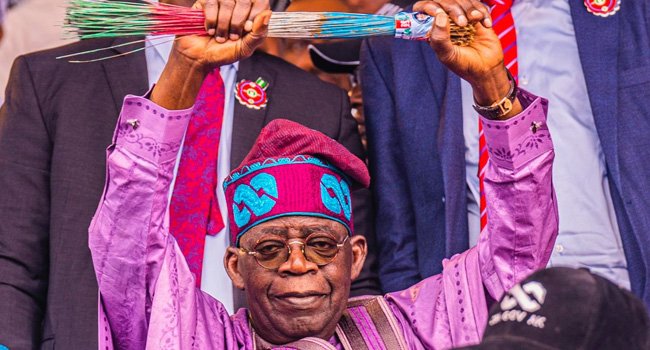
President Bola Tinubu Accepts INEC Chairman’s Departure and Bestows National Honour
President Bola Tinubu has formally accepted the departure of Professor Mahmood Yakubu as Chairman of the Independent National Electoral Commission (INEC) following the expiration of his second and final tenure. The President is set to name Yakubu’s successor after a meeting of the Council of State in Abuja on Thursday, where a list of nominees for the position will be presented.
Yakubu handed over to May Agbamuche-Mbu, a seasoned legal expert, who has assumed the role of acting chairman pending the appointment of a substantive successor. In recognition of his service, the President conferred upon the ex-INEC boss the national honour of Commander of the Order of the Niger.
Former Presidents Olusegun Obasanjo and Goodluck Jonathan, state governors, and other members of the Council of State are expected to advise Tinubu on the next INEC chair. Bayo Onanuga, Special Adviser to the President on Information and Strategy, stated that Tinubu thanked Yakubu for his services to the nation and efforts to sustain Nigeria’s democracy through free and fair elections during his two-term tenure.
In a letter dated October 3, 2025, Yakubu expressed gratitude to the President for the privilege of overseeing the commission for two terms. Tinubu, in turn, thanked him for sustaining Nigeria’s democracy and conducting elections he described as “free and fair” across his tenure.
Yakubu was first appointed in November 2015 as INEC’s 14th chairman for a five-year term. Following Senate confirmation, he was reappointed in 2020 for another five years, now concluded. Over the decade, Yakubu oversaw the 2019 and 2023 general elections and numerous off-cycle polls.
Under his leadership, INEC introduced the Bimodal Voter Accreditation System (BVAS) for voter verification and the Results Viewing Portal to allow instant public access to polling unit results. BVAS was piloted during the Anambra governorship election in November 2021 and fully implemented nationwide during the 2023 general elections.
Yakubu institutionalised a system of continuous registration and updates of voter records, increasing the number of polling units significantly to bring election access closer to many communities. He championed a consistent election timetable while increasing collaboration with political parties, civil society organisations, international observers, and media to ensure better oversight and trust in the process.
He established the Election Monitoring and Support Centre and other predictive systems to track performance across polling units using performance indicators. Under his leadership, INEC introduced provisions to support persons with disabilities, priority voting for the elderly and vulnerable groups, and measures to ensure internally displaced persons could better participate.
Despite challenges, Yakubu managed to preserve INEC’s institutional independence, continuously emphasizing neutrality and adherence to constitutional guidelines. However, his tenure faced controversies, including technical glitches and delays in the 2023 election, and accusations of bias from political actors.
Ifedayo Adedipe, Senior Advocate of Nigeria, dismissed the debate over who should appoint the INEC chair, arguing that the challenges undermining Nigeria’s elections were not tied to who headed INEC but to the conduct and mindset of political actors and citizens.
Adedayo Adedeji, SAN, maintained that nothing was wrong with the President appointing Yakubu’s successor, noting that the Senate confirmation process provides checks and balances. He called for extensive consultation prior to any appointment to ensure a well-rounded decision.
Wale Balogun, SAN, proposed a credible selection process, stating that the checks and balances in the system are sufficient to produce a reliable INEC umpire. He emphasized the need for a rigorous screening process to guarantee a credible electoral system.
Yakubu handed over to May Agbamuche-Mbu as the acting chairman of the commission on Tuesday at the INEC headquarters in Abuja. He explained that he was stepping down in accordance with Section 306, Subsections 1 and 2 of the 1999 Constitution (as amended). Yakubu expressed gratitude to colleagues, stakeholders, civil society groups, development partners, and Nigerians, acknowledging their roles in supporting electoral processes during his tenure.
As part of his farewell, Yakubu presented two publications documenting the commission’s work during his tenure: ‘Election Management in Nigeria 2015–2025’ and ‘Innovations in Electoral Technology 2015–2025.’ He outlined the Commission’s preparations for several upcoming elections, including the Anambra State governorship election next month, the Area Council election in the Federal Capital Territory in February 2026, the Ekiti State governorship election in June 2026, and the Osun governorship election in August 2026.
Agbamuche-Mbu is a seasoned legal practitioner with over 30 years of experience advising a diverse range of clients in both the public and private sectors. She was confirmed as INEC’s National Commissioner in 2016 and has a strong background in Alternative Dispute Resolution.
Meanwhile, Speaker of the House of Representatives, Tajudeen Abbas, pledged the commitment of the parliament to championing reforms in electoral, economic, and security sectors. He highlighted the need for constitutional amendments, electoral reforms, and security reforms, including multi-level policing.
Abbas emphasized the importance of legislative measures to speed up the implementation of the Start-up Act, vocational training hubs, and technology parks. He also stressed the need for progressive legislation to promote renewable energy and attract private investment to stabilize power supply and stimulate growth.
On insecurity, Abbas argued that the security agencies had disrupted insurgent networks and rescued abducted citizens. He called for targeted legislative actions to address high living costs, underemployment, and insecurity in some areas.


