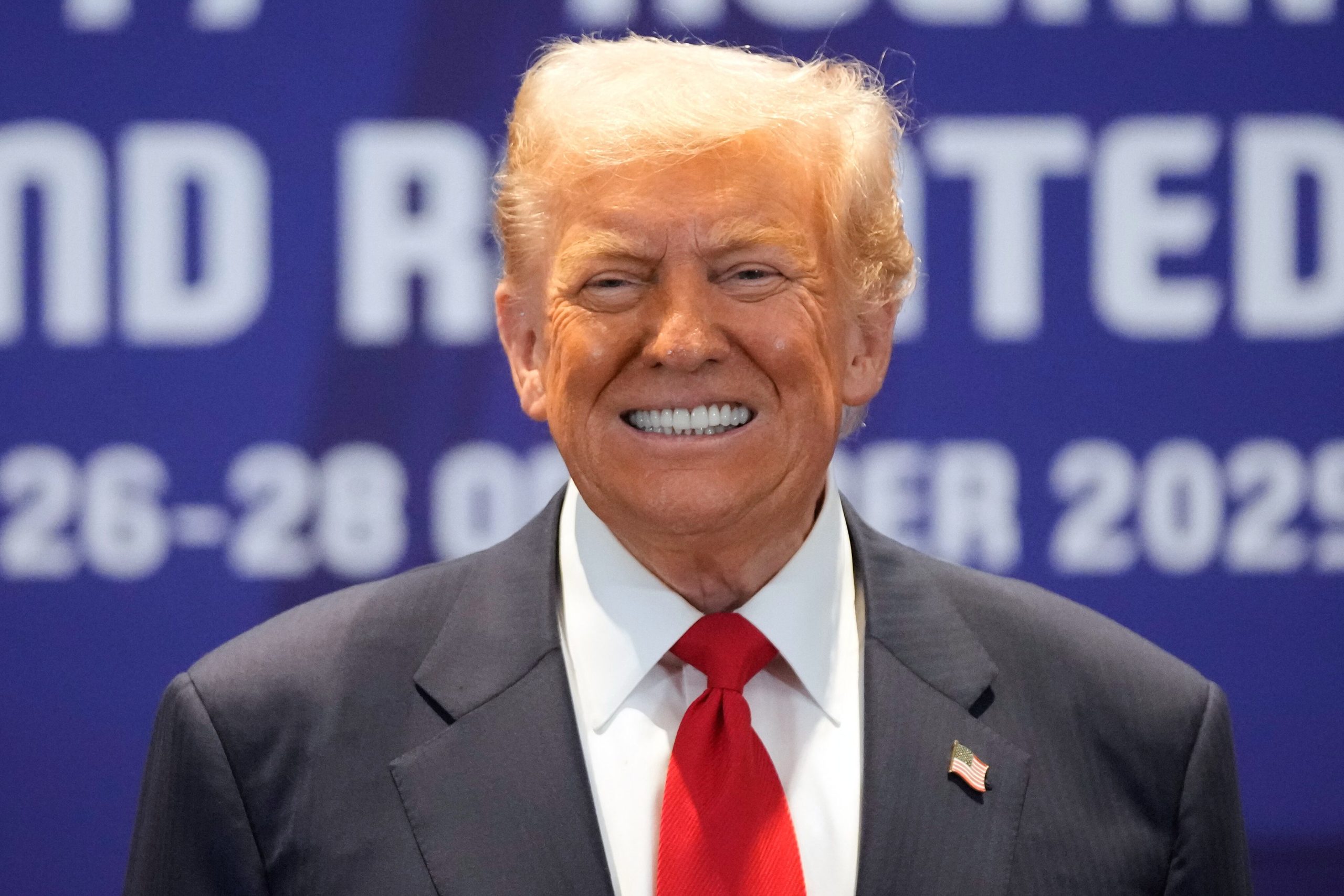
Trump’s Openness to Meeting Kim Jong-un and the Implications
U.S. President Donald Trump, during his first Asia tour after returning to power, expressed openness to meeting North Korean leader Kim Jong-un. He stated, “I am 100% open. If he contacts me, I will meet.” Regarding North Korea’s precondition for dialogue—the recognition of its status as a ‘nuclear-armed state’—Trump remarked, “I consider them a kind of ‘nuclear power.’ They have many nuclear weapons.”
The White House has confirmed that there are no plans for a meeting with Kim Jong-un during this visit. Additionally, North Korea is in a situation where Choe Son-hui, the vice foreign minister responsible for practical affairs, is away from Pyongyang due to a visit to Russia. However, given Trump’s tendency for surprise moves, the possibility of an unexpected meeting remains open.
On the 25th aboard his dedicated aircraft, Trump responded to a question about meeting Kim Jong-un during the APEC summit in Busan by saying, “The last time I met him, I announced on the internet that I was coming to Korea. He must know I’m coming.” In June 2019, during a visit to Japan, Trump proposed a meeting with Kim Jong-un via Twitter, which was realized in just 32 hours.
Trump’s reference to North Korea as a ‘nuclear power’ is interpreted as a response to Kim Jong-un’s statement last month that “if the U.S. abandons its delusional obsession with denuclearization, there is no reason not to face each other.” The term ‘nuclear power’ differs from the ‘nuclear weapon state’ recognized by the international community, referring to de facto nuclear-armed states like India and Pakistan. While this is not the first time Trump has used the term, his visit to South Korea and direct acknowledgment of Kim’s precondition for dialogue mark a step further. This has raised concerns that a U.S.-North Korea meeting could result in Trump abandoning ‘denuclearization’ and effectively recognizing North Korea’s nuclear capabilities.
Potential for a Surprise Meeting
Trump’s visit to South Korea is scheduled for one night and two days, with a summit meeting with President Lee Jae-myung on the 29th and with Chinese President Xi Jinping on the 30th. The afternoon of the 30th has no separate schedule. In terms of physical time for a U.S.-North Korea meeting, it is sufficient. A senior White House official said in a pre-visit briefing, “There are no plans for a meeting with Kim Jong-un in this tour schedule,” but added, “Of course, changes can occur.” Observations suggest the meeting has become difficult as Choe Son-hui, who played a key role in the 2019 U.S.-North Korea meeting at the inter-Korean truce village of Panmunjom, is visiting Russia and Belarus ahead of Trump’s arrival. However, a diplomatic source said, “If the two leaders have the will, the presence or absence of the vice foreign minister is not significantly important.”
From Trump’s perspective, the highlight of this Asia tour is the face-to-face meeting with Chinese President Xi Jinping, the first in six years. However, excluding temporary agreements like the extension of retaliatory tariff postponement set to expire on November 10th, it is uncertain whether the U.S. and China can reach consensus on key issues such as export controls on rare earths, suspension of U.S. soybean imports, and fentanyl trafficking. Additionally, the Ukraine war, which Trump has prioritized since taking office, shows no signs of resolution after nearly a year, and the implementation of the Israel-Hamas ceasefire agreement is already faltering. For this reason, there is a strong incentive to pursue a ‘surprise show’ with Kim Jong-un to maximize diplomatic achievements. Unlike in 2019, Trump is the one more eager for the meeting. In fact, ahead of his visit, the U.S. attempted to engage North Korea through various channels and requested cooperation from the South Korean government. A diplomatic source said, “Trump is willing to go to Pyongyang, not just Panmunjom, if asked.”
Implications for South Korea and Regional Stability
If U.S.-North Korea dialogue is realized in a situation where Trump is ‘eager,’ it could be perceived as tolerating North Korea’s nuclear capabilities, which would have significant repercussions for South Korea. Kim Jong-un said last month, “I have good memories of Trump,” and added, “If the U.S. abandons its delusional obsession with denuclearization and acknowledges reality, there is no reason not to face each other.” This reflects a calculation that North Korea wants political recognition as a ‘nuclear-armed state’ with sanctions relief and aims to establish normal bilateral relations. Trump’s repeated references to North Korea as a ‘nuclear power’ are primarily intended to bring them to the negotiating table, but dialogue without denuclearization discussions is likely to lead to the freezing or toleration of North Korea’s nuclear capabilities. Already, U.S. political circles argue that “the negotiation goal with North Korea should shift from complete denuclearization to arms control focusing on limiting nuclear weapons.” In this case, worst-case scenarios such as the suspension of South Korea-U.S. joint exercises, partial reduction, or withdrawal of U.S. troops in South Korea could materialize.
The South Korean government views the possibility of U.S.-North Korea dialogue during Trump’s visit as low. A high-ranking official said, “Although the 2019 Panmunjom meeting appeared sudden, there were many behind-the-scenes contacts,” and added, “This time, no such signs are visible, so the actual possibility is less than 5%.” However, if a meeting occurs, the government will actively support it. President Lee Jae-myung, during his August visit to the U.S., told Trump, “If you act as a peacemaker, I will support as a pacemaker.”
Victor Cha, the Korea Chair at the Center for Strategic and International Studies (CSIS), responded to this newspaper’s inquiry about whether President Lee Jae-myung could join a Trump-Kim meeting by saying, “The South Korean government would want to participate, but it is unclear if Trump would agree,” and added, “I’m not sure what value a meeting including South Korea would add for Trump.”
Nuclear Power vs. Nuclear Weapon State
The U.S., Russia, China, France, and the U.K., officially recognized under the 1968 Nuclear Non-Proliferation Treaty (NPT) as possessing nuclear weapons manufacturing and operational technology, are ‘nuclear weapon states’ (Nuclear Weapon State). In contrast, countries believed to have de facto acquired nuclear weapons technology through their own tests are referred to as ‘nuclear powers’ (nuclear power), including India, Pakistan, and Israel.