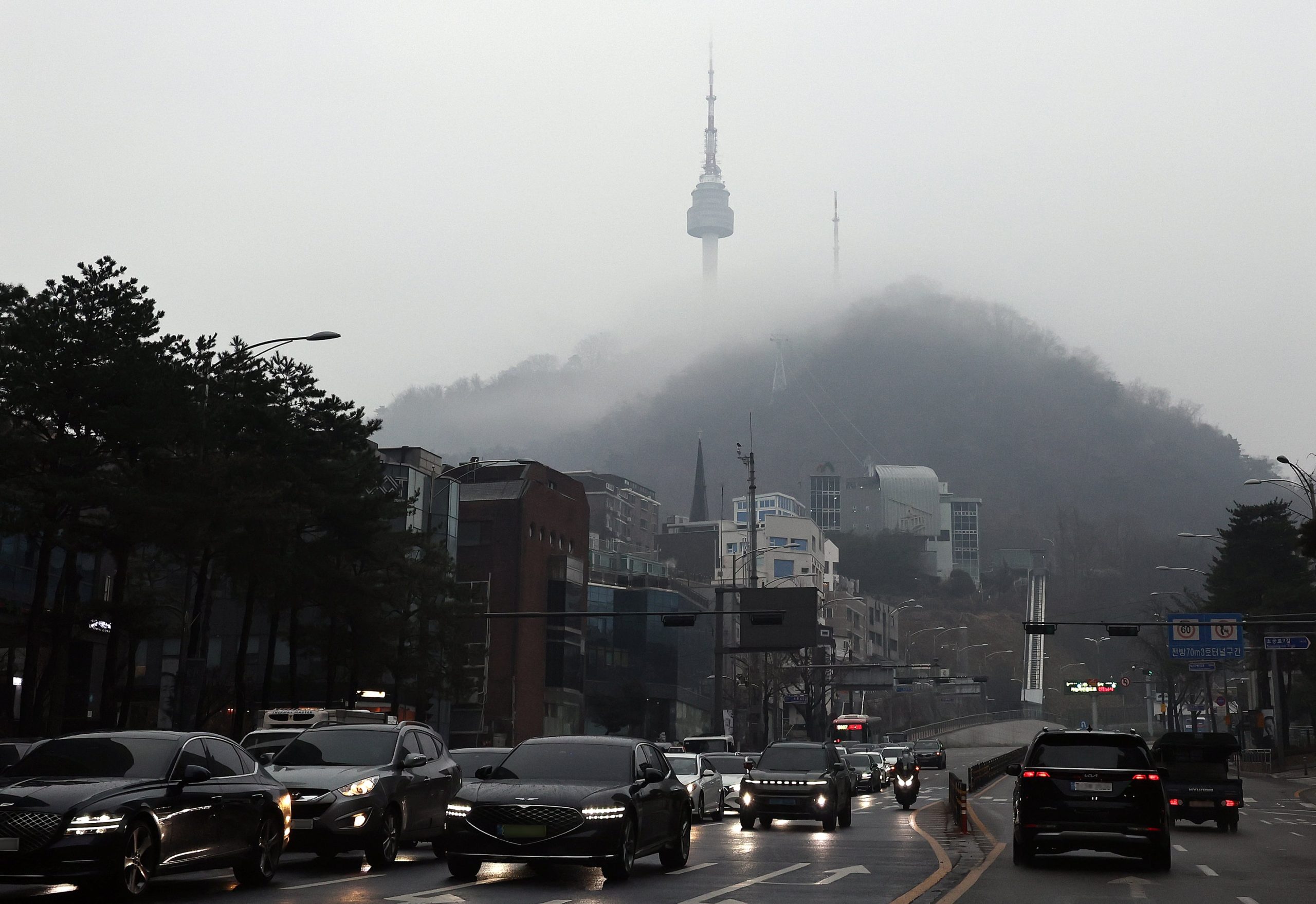
On the 13th, in the afternoon, the Gwacheon Tunnel connecting Gwacheon, Gyeonggi Province, to Yangjae, Seoul. Until entering the tunnel, snowflakes were blowing strongly, but after passing through the tunnel, drizzle fell. The same cloud band caused snow in Gwacheon and rain in Seoul. The temperature of the city is cited as the reason that separated snow and rain. It means that Seoul’s higher temperature than Gwacheon changed the precipitation pattern.
The “urban heat island” effect is accelerating winter warming. An urban heat island is a phenomenon where urban areas have higher temperatures than their outskirts. In cities lacking green spaces, asphalt roads heat up under sunlight during the day, and greenhouse effects caused by air pollution, along with “artificial heat” emitted by factories, vehicles, and air conditioner outdoor units, raise the overall urban temperature. While the heat island phenomenon is widely known to exacerbate heatwaves in summer, it also causes environmental issues in winter by reducing snowfall and spreading fine dust.
The 13th was forecasted as a day of “heavy snowfall in the capital region.” From the afternoon, cold air from the north passed over the relatively warm West Sea, forming a large precipitation cloud band that slowly moved over the capital region. Indeed, on that day, significant snowfall was recorded in Yangpyeong (4.1 cm), Gwangju (4.1 cm), and Yeoncheon (3.6 cm) in Gyeonggi Province. The automatic weather station (AWS) on Gwanaksan Mountain in Gwacheon recorded snowfall of 8.8 cm, exceeding the heavy snow warning threshold of 5 cm or more.
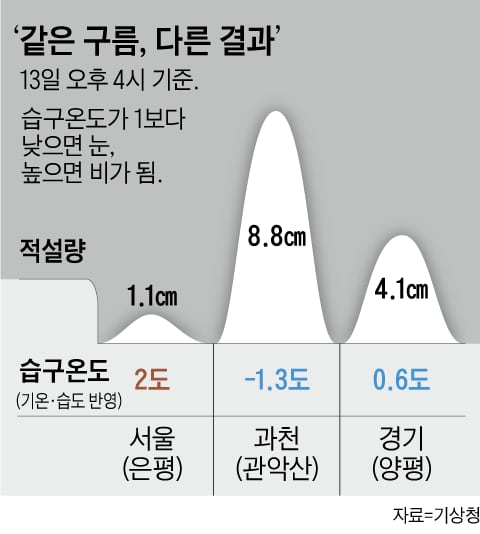
However, Seoul residents hardly saw any snow that day. This was because rain fell instead of snow. Yongsan and Seocho Districts received no snowfall, while Seodaemun (0.6 cm), Jongno (1 cm), and Eunpyeong (1.1 cm) Districts experienced minimal snowfall as temperatures dropped significantly in the late afternoon, causing some rain to turn into snow. One might assume the cloud band bypassed Seoul and only passed through other parts of the capital region, but the cloud band, which swept across the entire capital region after passing over the West Sea and moved eastward, dumped nearly 5 cm of snow in Yangpyeong, east of Seoul. Ultimately, this implies there was another variable that separated snow and rain despite the same cloud band passing through.
The variable that can explain this is the “wet-bulb temperature.” Wet-bulb temperature reflects air temperature, heat, humidity, and other factors. When a cloud band passes through a specific area, if the wet-bulb temperature is 1 degree Celsius or higher, it is more likely to rain, whereas if it is below 1 degree Celsius, snow is more likely. As of 4 p.m. on the 13th, when snowfall began in earnest, Seoul (Eunpyeong) had a wet-bulb temperature of 2 degrees Celsius, while Gwacheon (Gwanaksan) was at -1.3 degrees Celsius and Yangpyeong at 0.6 degrees Celsius, both lower than Seoul. This indicates that Seoul itself was warmer than other regions. The Korea Meteorological Administration stated, “If temperatures had dropped significantly below -5 degrees Celsius, heavy snow would have fallen in Seoul as well. However, since temperatures fluctuated around 0 degrees Celsius that day, Seoul’s ‘heat island’ effect can be seen as a factor that reduced snowfall.”
When the heat island effect occurs, snow turns into rain, or even if snow falls, it melts without accumulating on the ground. Accumulated snow slowly melts, keeping the ground moist until spring, but if it falls as rain, it dries quickly, increasing dryness as spring approaches. The Korea Meteorological Administration forecasts that this winter (December to next February) will be warmer than usual, suggesting that precipitation that should have fallen as snow may turn into rain, or puddles may form instead of accumulated snow, becoming a more frequent occurrence.
The heat island effect also deteriorates air quality. On the afternoon of the 16th, fine dust originating from China entered the country and failed to disperse, leading to “unhealthy” fine dust (PM2.5) levels in the capital region and Chungcheong Province. When the ground heats up due to the heat island effect, upward air currents are generated, disrupting horizontal airflow and trapping fine dust. The National Institute of Environmental Research predicted that on the 17th, fine dust levels would be “unhealthy” nationwide. Until the weekend, dense fine dust concentrations are expected to persist in the capital region.
Urban Heat Island
A phenomenon where urban areas have higher temperatures than their outskirts. Causes include asphalt roads that absorb sunlight and retain heat during the day, greenhouse effects from air pollution, and artificial heat emitted by vehicles and air conditioner outdoor units.