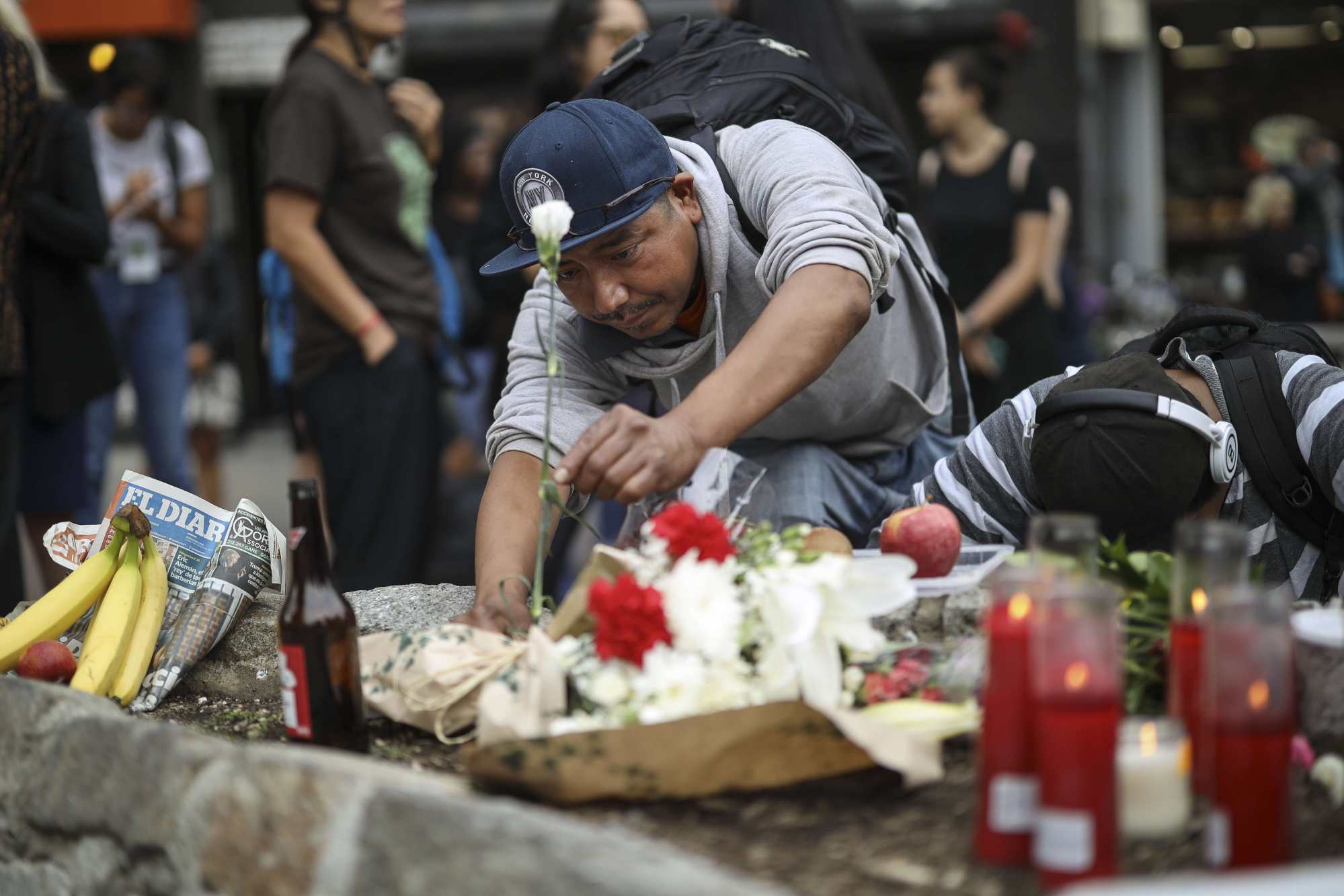
A Tragic Case of Homelessness, Mental Illness, and Violence
In 2019, Randy Santos committed a brutal act that left four homeless men dead in New York City’s Chinatown. The victims included 83-year-old Chuen Kok, an immigrant from Hong Kong who had lost his way after the death of his wife and the closure of his church. Others were Florencio Moran, Nazario Vasquez Villegas, and Anthony Manson, each with their own stories and lives that were abruptly cut short.
The courtroom on Thursday was devoid of any family members or friends of the victims to speak on their behalf. No one came forward to share the impact of these lives lost or to confront Santos directly. This absence highlighted the tragic reality of the case, where no one could provide a victim impact statement to the court.
Manhattan Assistant District Attorney Alfred Peterson expressed his sorrow during the sentencing, stating, “There are no victim impact statements here today. There’s nobody here to tell this court about their lives and how their absence is a loss.” He emphasized the value of every life and the gift of free will that was taken away by Santos’ actions.
Santos, who was convicted in February of first-degree murder, sat quietly in court, listening through headphones as a Spanish interpreter translated the proceedings. His lawyers argued that his schizophrenia had led him to believe he needed to kill 40 people or face death himself. They sought a psychiatric treatment facility instead of prison, but the judge was not convinced.
Judge Laura A. Ward described the case as a convergence of three significant issues in the city: homelessness, mental illness, and narcotics abuse. She noted that these factors often underlie violent crime cases. Santos’ defense attorney, Arnold Levine, urged the court to consider a more lenient sentence, arguing that Santos was not beyond redemption.
However, Ward acknowledged the difficulty in overlooking the fact that Santos targeted the most vulnerable members of society—homeless individuals sleeping on the streets. She emphasized that the victims were doing nothing but resting when they were attacked.
Prosecutors had requested a sentence of 50 years to life in prison. In addition to the murder charges, Santos was also convicted of attempted murder for assaults that left two other men severely injured. During the trial, surveillance footage showed Santos repeatedly striking victims with a 1.2-meter metal bar. A couple witnessed him attacking another man with the same weapon, which he had found on the street.
David Hernandez, the lone survivor of the half-hour killing spree, was critically injured and staggered to a nearby street where police were trying to revive another victim. Police later found Santos carrying the blood-stained bar, which contained his DNA and the blood of some of his victims.
After the sentencing, Karlin Chan, a Chinatown activist who arranged Kok’s funeral, commented that the decision provided closure for the community. He dismissed Santos’ apology as performative, stating, “He knew what he was doing. At the end of the day here, he’s going to a place where he deserves to be: jail.”
This case underscores the complex interplay between mental health, homelessness, and violence. It serves as a reminder of the importance of addressing these issues within our communities to prevent such tragedies from occurring again.