The Cultural Significance of Food in Nepalese Festivals
In Nepal, food plays a central role in the celebration of festivals, serving as a bridge between tradition, family, and community. Different ethnic groups have their own unique culinary practices that reflect their cultural identity and heritage. From the Tharu to the Tamang, Newa, and Rai communities, each has its own set of dishes that are prepared during major festivals like Dashain and Tihar.
Tharu Community: A Taste of Tradition
Deepika Chaudhary from Itahari, Sunsari, highlights how food is at the heart of every celebration in the Tharu community. During festivals, people come together to enjoy traditional dishes such as Ghonghi (snails), andik bhaat (sticky rice), and telpaur roti, a fried bread made by mixing rice flour with hot water and deep frying it in oil. These meals are not just about nourishment but also about bringing people together.
One of the most unique delicacies in the Tharu culture is sidhara, which is made from taro or colocasia stems, dried fish, and spices. The ingredients are ground together, shaped into small cakes, and sun-dried for future use. When cooked into a curry or soup, sidhara releases a strong, fermented aroma that sets it apart. There’s also a variation that Deepika recalls vividly—colocasia leaves and stems are dried in the sun, powdered, and mixed with ground dried baby fish. The mixture is shaped into small rings and cooked in the same way as sidhara, adding an extra layer of flavor and texture.
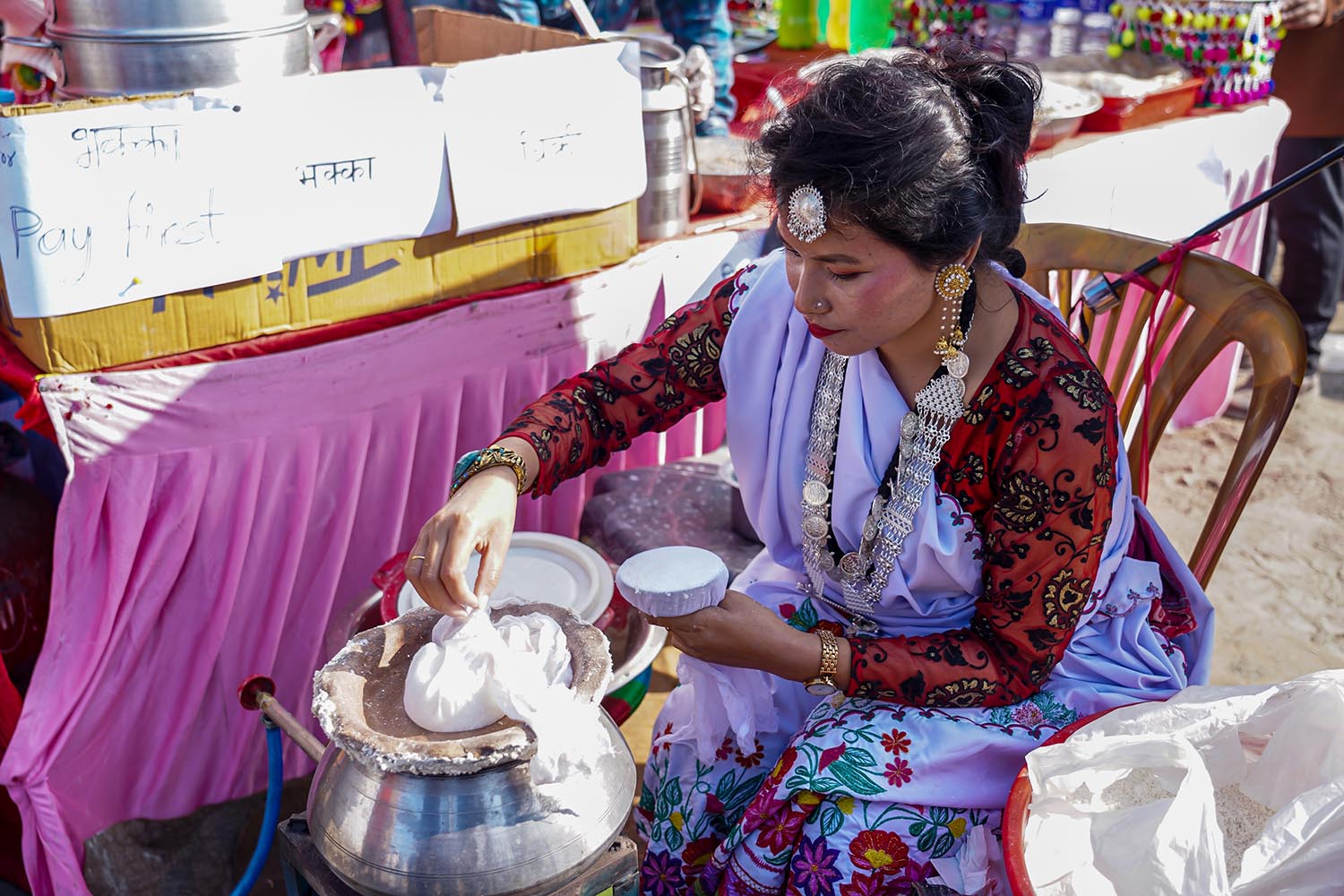
Another festive favorite is sidhraak chutney, a sharp and flavorful side dish made from dried baby fish and spices. As winter approaches during Dashain and Tihar, Tharu households also prepare bhakka, a soft and fluffy rice cake that offers comfort in the cool weather.
For the Tharu community, these dishes are more than just food; they are a way of inviting festive seasons, marking the change in seasons, strengthening family bonds, and carrying forward flavors that have been part of their culture for generations.
Tamang Community: A Feast of Heritage
Dawa Tamang from Kavre explains that food is deeply woven into the rhythm of festivals in the Tamang community. During Dashain and Tihar, families gather to prepare meals that reflect both tradition and togetherness. While many Nepali households focus on goat meat, the Tamang community enjoys pork as a central part of their celebrations.
Alongside this, sel roti, homemade alcohol, and fried breads are common, while gundruk and other fermented greens bring familiar flavors to the table. One of the most cherished delicacies is marinated pork, slow-cooked over firewood. The meat is rubbed with Sichuan pepper, ginger, garlic, and salt, then roasted or simmered into a thick gravy served with rice.
During Tihar, khapse—crispy, twisted fried dough—is prepared in large batches, often shared with relatives and neighbors. The balance of meat, grains, and fermented vegetables makes the food both flavorful and practical for large family gatherings.
For the Tamang community, these foods are more than just festive meals—they are carriers of memory and identity. “Each Dashain we cook the way our grandparents did,” Tamang says, “using traditional tools and firewood, not just modern stoves.” Cooking together, exchanging food with neighbors, and savouring dishes rooted in their land reflect resilience and belonging. In this sense, food becomes a reminder of heritage and a way of keeping the community spirit alive during Nepal’s biggest festivals.
Newa Community: Rituals and Offerings
Smriti Shrestha from Bhaktapur shares that food is central to celebrating festivals in her culture. On Ghatasthapana, families keep jamara and sacrifice a buffalo, offering its blood and meat to deities Bhimsen and Durga at the doorway. The meat is then eaten throughout the festival by the family. In earlier times, from this day until Tika, people would go to the river each evening, light diyo (oil lamp) as part of a ritual until the stars appeared in the sky, and only then eat their meal. Today, however, this practice is less common.
On Phulpati day, families prepare different offerings depending on what they can afford—duck, goat, sheep, or buffalo. After the bhog (a religious offering of food to a deity), the family gathers to enjoy samay baji (a traditional Newa dish). Ashtami has its own unique food traditions. The white part of the egg is offered to deities Ganesh, Bhimsen, and Durga, while the yellow yolk is taken home and eaten with samay baji, which also includes sidra fish and choila. Because cooking rice is avoided on Ashtami, families prepare a meal called kuchi bhwey, which is served on a banana leaf and features four varieties of lentils, gundruk, soybeans, yogurt, and assorted meats.
Nawami brings another food-related ritual. A sacred fire is lit inside a clay pot, into which ghee is added before the fire, and it is carried around the house. This is believed to invite and honor the gods, and even in this act, food is at the heart of the practice. Families are also allowed to eat on this day, but one rule is that ghee must be included in the meal.
During Tika, unlike among Bahun and Chhetri families, the tika is first placed on sugarcane leaves and offered to Ganesh, Bhimsen, and Durga at a crossroads. Only after the deities are honored do people apply tika on themselves. “For the Newa people, the tika days last only until the day before the full moon. Afterwards, the celebrations shift into shared feasts with family and community,” says Shrestha.
Rai Community: A Unique Celebration
Sarita Rai from Lagankhel shares that Dashain is not celebrated uniformly among Rai people. “In many Rai villages, Dashain was never our tradition. It only came into practice in places where the Bahun and Rai families lived together, and even then, we celebrate it differently. We don’t use the red tika—instead, we place plain white rice as tika,” she says.
Food during Dashain in Rai households generally focuses on meat and alcohol. Goat, mutton, or pig meat is common, and pig leg achaar is often prepared. Locally brewed beer, chyang, is also included in some gatherings. A popular dish in eastern Nepal is rayo ko saag, cooked with fatty pig meat, where the slight bitterness of mustard greens pairs with the richness of the meat.
Another staple is dhido, made from millet, maize, or buckwheat flour; it is thick and usually eaten with meat curries or fermented bean dishes such as kinema (fermented soybeans). Other foods on the Dashain table include lentils, rice, and vegetable curry, complemented by goat or mutton curries. Preserved foods like sukuti (dried meat) are also included. Goat pakku and mutton curry are often eaten with beaten rice, a classic festive combination.
“For us, Dashain food is less about fixed rituals and more about enjoying what we have—meat, drink, and shared meals with family. It’s about adapting traditions in our own way,” says Rai.


